sábado, 5 de enero de 2013

Korsun-Cherkassy pocket #4: Smella - AAR

(english text below)


Campaña: Korsun-Cherkassy #4 - Smella
Misión: No Retreat (alemanes defienden)
Resumen: Con el avance alemán detenido, Konev lanza un contraataque en fuerza al sur de Smella para romper el frente antes de que la Wehrmacht consolide sus líneas.

Campaign: Korsun-Cherkassy #4 - Smella
Mission: No Retreat (Germans defending)
Briefing: With the German advance halted, Konev launches a full-force counterattack south of Smella to shatter the front before the Wehrmacht can consolidate its gains.


Gvardeyskiy Strelkovy Batalon

  • HQ +AT Platoon
  • Strelkovy Rifle Company (2x Platoons + Komissar +HMG)
  • Strelkovy Rifle Company (1x Platoon + Komissar)
  • Heavy Mortar Company (6x 120mm)
  • Tank Destroyer Company (4x ZIS-2)
  • Gvardeyskiy Tyazhelyy Tankovy Company (4x IS-2 +Tank escorts)
  • Sapper Company (2x Platoons)

1. / I. Füsilier-Regiment 'Feldherrnhalle'

  • Kompaniegruppe: 2x Panzerfaust +Sniper
  • 1. Zug (Panzerfaust)
  • 2. Zug (Panzerfaust)
  • 3. Zug (Panzerknacker)
  • schwere PzG-zug (2x GW 34 +4x HMG)
  • Panzerjägerzug (3x PaK 40)
  • 12cm Granatwerferzug
  • schwere Panzerjägerzug (2x Nashorn)
  • Panzeraufklärungszug (3x Sd.Kfz. 250)
  • Nebelwerferzug (3x NW41)
  • Luftwaffe Fliegerabwehrzug (2x FlaK 36)


The Battlefield


El campo de batalla, de Oeste (izquierda) a Este (derecha)
The Battlefield, from West (left) to East (right)

El área al sur de Smella es una llanura abierta cruzada de Norte a Sur por el arroyo Sukhoy Tasklyk, con granjas dispersas, colinas suaves, bosques y caminos de tierra. Tras el fracaso de la ofensiva, los Panzergrenadier de la División 'Feldherrnhalle' son los encargados de cubrir la retirada de las maltrechas tropas alemanas ante la inminencia de un contraataque encabezado por los nuevos IS-2. Si los soviéticos consiguen la victoria, la retirada alemana se convertirá en una desbandada; en caso contrario, los Panzergrenadiers ganarán un tiempo precioso para reposicionarse en nuevas posiciones defensivas.

El campo de batalla, visto desde el Este
The Battlefield, seen from the East

The area south of Smella is an open plain crossed from north to south by Sukhoy Tasklyk, a narrow stream, with scattered farms, gentle hills, forests and dirt roads. After the failure of German offensive in Smella, Panzergrenadiers from 'Feldherrnhalle' Division have been tasked to cover the German withdrawal under the imminence of a furious Soviet counterattack spearheaded by the new IS-2 tanks. If Soviets grasp victory, German retreat will turn into a rout; otherwise, the stubborn Panzergrenadiers will gain precious time for the rest of XLII Korps to build new defensive positions.


Objectives
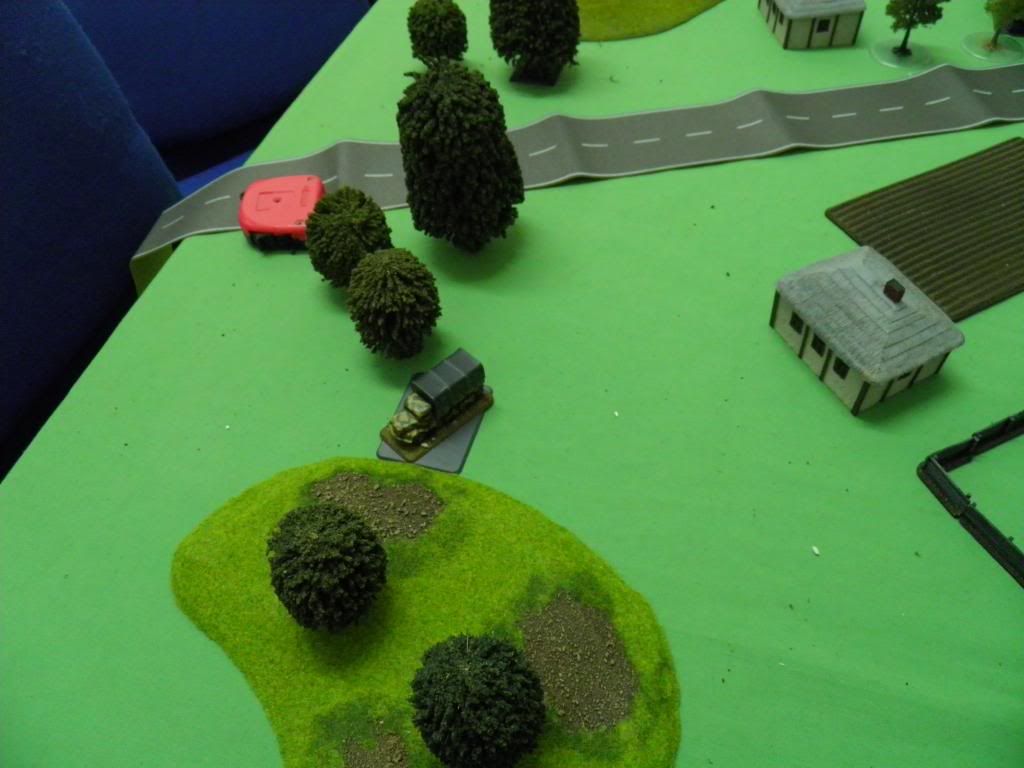


Deployment


A la hora de desplegar, hice algunos Combat Attachments del Heavy Platoon: 1x HMG al 1. Zug y los 2x GW 34 al 2. Zug. Estos dos pelotones llevarán a cabo la tarea de mantener la línea, reforzados con los equipos Panzerfaust del HQ. Teniendo en cuenta que la artillería soviética iba a empezar en posiciones preparadas elegí mi pelotón de morteros de 12 cm para hacer fuego de contrabatería. Dos Nashorn supervivientes del 525. sPzJAbt se ocultarán en una colina boscosa, en espera de los tanques soviéticos. Por último, el Pelotón de Pak 40 permanecerá en Emboscada, con la esperanza de obtener algunos impactos laterales en los gigantes soviéticos.

In order to deploy, I made some combat attachments from the Heavy Platoon: 1x HMG to 1. Zug and 2x GW 34 to 2. Zug. These two Platoons will hold the line, reinforced with the HQ Panzerfaust teams. Taking into account that Soviet Artillery would begin game in Prepared Positions I chose my 12cm Mortar Platoon to make some counterbattery fire. Two surviving Nashorns from 525. sPzJAbt will hide in a wooded hill, waiting for the Soviet tanks to appear. Finally, The Pak 40 Platoon will remain in Ambush, hoping to get some nice side shots on the Soviet behemoths. 


Por su parte, el comandante soviético decide desplegar su fuerza a lo largo todo el frente, situando a los IS-2 en la carretera en una maniobra de avance previsible hacia el objetivo cercano.

On the other side, the Soviet commander decides to deploy his forces along the entire front, placing the IS-2 on the road in a predictable move towards the closer objective.

lunes, 31 de diciembre de 2012

8.8cm FlaK 36/37

(English text below)


El 8.8cm FlaK 18/36/37 fue, por méritos propios, uno de los cañones más famosos y temidos no sólo de la Segunda Guerra Mundial, sino de todos los tiempos. Fue empleado por las diversas ramas de la Wehrmacht, en un principio como cañón antiaéreo, pero ya durante la Guerra Civil Española tuvo tanto éxito como contracarro que fue adoptando cada vez más este rol, hasta el punto que se desarrolló una versión del 88 expresamente adaptada para ser instalada en carros de combate como el Tiger I, con la denominación de KwK 36.


The 8.8cm FlaK 18/36/37 was, in its own right, one of the most feared and famous guns not only of World War II, but all time. It was employed by several branches of the Wehrmacht, initially as an anti-aircraft gun, but yet during the Spanish Civil War it proved itself as a successful anti-tank platform. Since then, the '88' was increasingly adopting this role, to the point that it was developed a lighter version, labeled KwK 36, specifically intended to arm heavy tanks like the dreaded Tiger I.


sábado, 22 de diciembre de 2012

Korsun-Cherkassy pocket #3: Smella - AAR

(english text below)

Campaña: Korsun-Cherkassy #3 - Smella
Misión: Fighting Withdrawal (británicos defienden)
Resumen: la Wehrmacht decide tomar al asalto el pueblo ucraniano de Smella para recuperar su vital cruce de caminos y romper en dos el 2º Frente Ucraniano de Konev.

Campaign: Korsun-Cherkassy #3 - Smella
Mission: Fighting Withdrawal (brits defending)
Briefing: The Wehrmacht decides to assault the Ukrainian village of Smella to retake their vital crossroads and split Konev's 2nd Ukrainian Front in two.


III. Batterie / 239 Sturmgeschütz-Abteilung


  • Gruppe Führer: 2x Panzer IV Ausf.H
  • 1. Zug (2x StuG IIIG +1 StuH 42 +Begleit)
  • 2. Zug (2x StuG IIIG +1 StuH 42 +Begleit)
  • 3. Zug (2x StuG IIIG +1 StuH 42 +Begleit)
  • schwere Panzerjägerzug (2x Nashorn)
  • Inganteriezug (Sturm)
  • Aufklärungszug (Sturm)
  • Nebelwerferzug (3x NW41)

Rifle Company (50th Infantry Division 'Northumbrian')


  • HQ
  • Rifle Platoon
  • Rifle Platoon
  • Rifle Platoon (Campaign bonus)
  • Mortar Platoon
  • Anti-tank Platoon (4x 6 pdr)
  • Assault Anti-tank Platoon (SP), Royal Artillery (4x M10 3")
  • Assault Field Battery, Royal Artillery (8x OQF 25 pdr)
  • Carrier Platoon
  • Sherman Platoon
  • Sherman Platoon

The Battlefield


El campo de batalla, de sur (lado más alejado) a norte (más cercano)
The Battlefield, from South (farther) to North (closer)

El área al suroeste de Smella es una llanura abierta cruzada de Norte a Sur por el arroyo Sukhoy Tasklyk, con granjas dispersas, pequeños bosquecillos y caminos de tierra. El 239. StuG-Abteilung encabezará el asalto del pueblo, defendido por los infantes de la 50th ID 'Northumbrian', que arden en deseos de vengar a sus compañeros caídos en las jornadas anteriores. Si la Wehrmacht logra la victoria, la pinza sur quedaría partida en dos, quedando aislados dos Ejércitos soviéticos (el 52º y el 5º Aéreo); en caso contrario, perderían la iniciativa táctica, con las fuerzas alemanas peligrosamente extendidas en un saliente de imposible defensa.

The area southwest of Smella is an open plain crossed from north to south by Sukhoy Tasklyk, a narrow stream, with scattered farms, small groves and dirt roads. 239. StuG-Abteilung is committed to lead the assault on the town, defended by the stubborn infantry of 50th Infantry Division 'Northumbrian', eager to avenge his fallen comrades in the previous days' fights. If the Wehrmacht achieve victory, the south pincer would be split in two, isolating two Soviet Armies (52nd Army and 5th Air Army), otherwise their tactical initiative will be lost, with German forces dangerously stretched on a narrow salient.


Objectives


Deployment


El tercer objetivo, al lado de la carretera principal
The last objective, close to the main road

El despliegue británico parece impresionante a primera vista, no obstante yo habría colocado a los 6-pdr en el centro para que no pudiesen ser ignorados fácilmente y habría asignado un pelotón de infantería completo a la defensa de cada objetivo.

The British deployment looks impressive at first glance, however I would have placed the 6-pdr in a commanding position in the center so they could not be easily ignored; also I would have committed a full infantry platoon to each objective.


Por su parte, el comandante alemán decide desplegar su fuerza en una delgada línea a lo largo todo el frente en lugar de concentrarla en un único sector, lo que a priori parece una decisión poco prudente.

On the other side, the German commander decides to stretch its force in a thin StuG line along the entire front rather than focusing on one point, what at first looks like an unwise decision.

sábado, 8 de diciembre de 2012

4. / 2109. Panzer-Abt.; Panzerbrigade 109 "FHH"

(English text below)


4.  / 2109. Panzer-Abteilung; Panzerbrigade 109 "Feldherrnhalle" [Grey Wolf]

Confident Veteran

Kompanie
# Gruppe Führer
    2x Panzer IV/70(V) ............................................=300p
> 1. Zug
    3x Panzer IV/70(V) ............................................=450p
> 2. Zug
    3x Panzer IV/70(V) ............................................=450p

Abteilung
> Fliegerabwehrzug
    2x Sd.Kfz. 7/1  ..................................................=100p

Brigade
> gepanzerte Panzergrenadierzug
    220p +10p (Panzerfaust) .................................=230p
> Panzeraufklärungszug
    3x Sd.Kfz.250 ..................................................=115p

Korps
> Nebelwerferzug
    3x NW 41 ...........................................................=105p

========================================1750p

Tras el éxito de los Kampfgruppen ad hoc (como el famoso Kampfgruppe Bäke) en las batallas defensivas que se sucedieron durante la ofensiva de Bagration, Hitler decidió crear unidades permanentes, más pequeñas y flexibles que las Panzerdivisionen para combatir las puntas de lanza acorazadas aliadas, esperando exportar la exitosa experiencia del Ostfront al frente occidental. Así nacieron las Panzerbrigaden, inicialmente del tamaño de un regimiento, con un Panzer-Abteilung y un Panzergrenadier-Bataillon. En las Panzerbrigaden 105-110 la 4. Kompanie del batallón Panzer estaba constituida por los nuevos y prometedores Panzer IV/70(V), con 11 ejemplares, armados con el poderoso PaK 42 del Panther (cañón, por cierto, que fue diseñado para equipar al Tiger I).

Following the success of the ad-hoc Kampfgruppen (like the famous Kampfgruppe Bäke) in the defensive battles after Bagration offensive, Hitler decided to create permanent formations, smaller and more flexible than Panzerdivisionen to face Allied armoured spearheads, expecting to export the successful experience from the Eastern Front to the West. Thus Panzerbrigaden were born, initially the size of a Regiment, that is: a Panzer-Abteilung and a Panzergrenadier-Bataillon. In Panzerbrigaden 105-110 the 4. Panzer Kompanie housed the new and promising Panzer IV/70 (V), -11 units- armed with the powerful PaK 42 the same as Panther (designed to equip the Tiger I).

jueves, 6 de diciembre de 2012

The shape of things to come

(English text below)


Recientemente, en mi grupo de juego hemos decidido introducirnos en los Wargames de escaramuzas a 20mm ambientados en la época actual (1980-2000), y para variar voy a comenzar a reunir una fuerza soviética / Federación Rusa. En un principio pensé en una compañía VDV (lo sé, como el 99% de los jugadores que juegan rusos), pero la dificultad de conseguir el equipo (no hay muchos BMD-2 disponibles por aquí) y unas figuras que me sedujeran hicieron que me decantase por una fuerza mecanizada de élite, en concreto, una agrupación de la 2ª División Mecanizada de la Guardia 'Tamanskaya', la famosa Guardia Taman o bien, de la 4ª División Acorazada de la Guardia 'Kantemirovskaya' (la División Kantemir). Tras la reforma del Ejército Ruso en 2009, las antiguas Divisiones  han sido transformadas en brigadas para aumentar su flexibilidad y su efectividad, pero nosotros jugaremos con anterioridad a esa fecha.


Recently, in my gaming group we decided to introduce ourselves into 20mm Modern Warfare (1980-2000), and this time I am assembling a Soviet / Russian Federation force. At first I thought of a company VDV (yeah I know, like 99% of guys playing Russian), but the difficulty of getting the necessary equipment (not many BMD-2 available here) and figures that pleased my eye made ​​me to turn my head to an elite mechanized force instead, namely a force from whether 2nd Guards Motor Rifle Division 'Tamanskaya', the famous Taman Guards or 4th Guards Armoured Division 'Kantemirovskaya' (Kantemir Division). I'm aware that after the reform of the Russian Ground Forces in 2009, the old Divisions were disbanded and split into brigades to increase their flexibility and effectiveness, but we'll play prior to that date, anyway.


sábado, 1 de diciembre de 2012

Vollkettenaufklärer 38(t) 'Kätzchen'

(English text below)


En 1943, el Heereswaffenamt Wa.Prüf-6 decidió impulsar el desarrollo de un nuevo vehículo de orugas para servir en tareas de reconocimiento y transporte de tropas para el Frente del Este, donde se requerían mayores capacidades de movimiento campo a través. Tanto Auto Union como BMM (Böhmisch-Mährische Maschinenfabrik) presentaron diversos prototipos bien entrado 1944, resultando ganadora la propuesta de BMM, que empleaba el venerable chasis del Panzer 38(t), y presentaba mayor movilidad, fiabilidad mecánica y protección que sus competidores.


In 1943, Heereswaffenamt Wa.Prüf-6 decided to develop a new fully-tracked vehicle fitted to meet the needs of Eastern Front's harsher conditions as a personnel carrier and a reconnaissance unit. Both Auto Union and BMM (Böhmisch-Mährische Maschinenfabrik) presented several prototypes well into 1944, being selected BMM's proposal, which was based on the venerable PzKpfw 38(t) and had greater mobility, mechanical reliability and armor protection than its competitors


sábado, 24 de noviembre de 2012

Korsun-Cherkassy pocket #3: Smella - Preview

(english text below)


26 de Enero de 1944. Contradiciendo el resultado histórico, la ruptura del frente no ha tenido lugar. En su lugar, una rápida contraofensiva de la Wehrmacht se ha abierto paso hacia la pequeña ciudad de Smella (hoy Smila), enfrentándose a una decidida defensa por parte de los restos de la 50th ID británica. El escenario a jugar será Fighting Withdrawal. Una victoria alemana forzaría una dolorosa retirada aliada hacia Cherkassy, amenazando con copar al 52º Ejército y al 5º Ejército Aéreo soviéticos y a parte de la BEF-Ukraine. En otro caso, la punta de lanza alemana se vería comprometida. Mientras tanto, Vatutin sigue avanzando hacia Zvenigorodka desde el Noroeste, esperando cerrar la Bolsa por su parte a riesgo de extender demasiado su línea de suministros...

Adicionalmente, para representar la superioridad local anglo-soviética:

>Los Aliados añaden un pelotón de infantería adicional sin coste

January 26, 1944. Contrary to the historical result, Soviet breakthrough has not taken place. Instead, a quick Wehrmacht counteroffensive has made its way to the small town of Smella (today Smila), facing a tenacious defence from the battered remains of British 50th ID. To represent this, we will play Fighting Withdrawal. A Greman victory will force the Allies back to Cherkassy, threatening to encircle the Soviet 52nd Army and 5th Air Army, and part of BEF-Ukraine. Otherwise, the German spearhead would be compromised. Meanwhile, Vatutin continues to advance towards Zvenigorodka from the Northwest hoping to close the pocket, at risk of overextending his supply line...

In addition, to represent Anglo-Soviet local superiority:

>The Allied player receives an additional full infantry platoon at no cost


Las fuerzas enfrentadas / The opposing forces:

>Del lado alemán, una StuG Batterie del 239. Sturmgeschütz Abteilung
>Del lado aliado, una compañía de rifles de la 50 ID británica


>On German side, a StuG Batterie from 239. Sturmgeschütz Abteilung
>On Allied side, a Rifle Company from British 50th ID 'Northumbrian'


El campo de batalla / The battlefield:


View Larger Map


Esta vez aplicaremos las reglas de tiempo invernal de la V3 (Devil's Charge, pág 84). La nieve, a diferencia de en la V2, es sólo Slow Going, lo que evitará que las partidas se ralenticen tanto.

This time we are applying the V3 winter weather rules present on Devil's Charge (page 84). Snow-covered terrain, unlike in V2, is now Slow Going (instead of Difficult Going), to prevent games from slowing down.